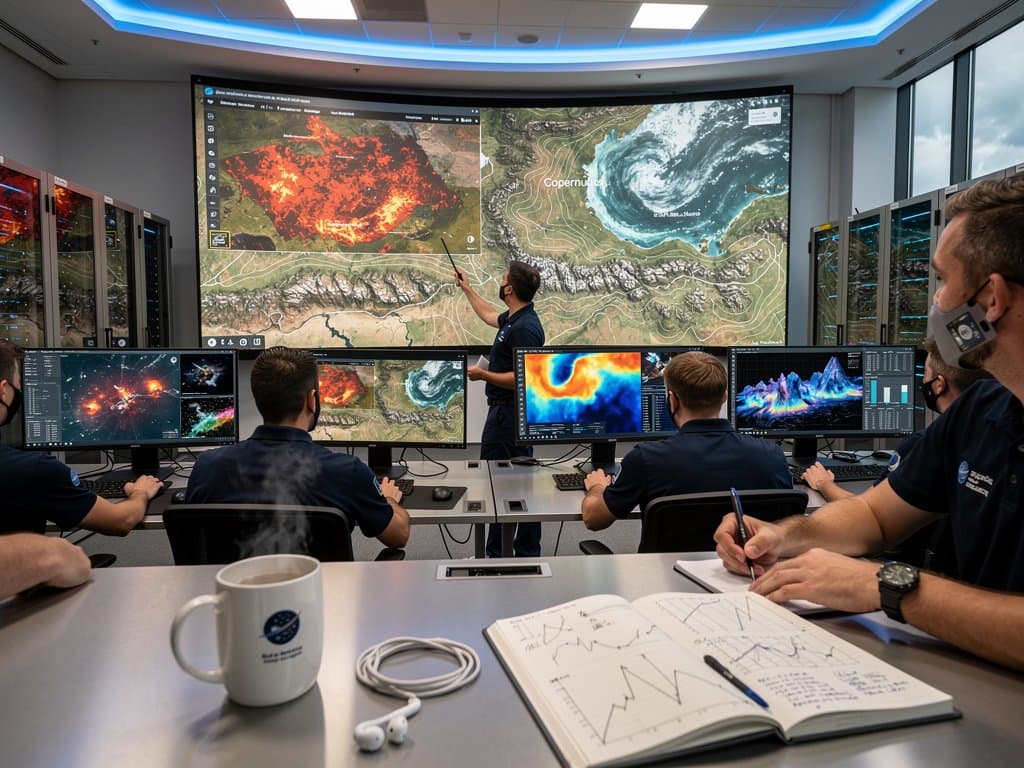
- 1. AI environmental monitoring analyzes Copernicus data for Green Deal flood and emission forecasts.
- 2. BTC reaches $77,336 USD, up 4%, amid MiCA scrutiny of proof-of-work energy use.
- 3. AI Act deems environmental AI high-risk, requiring audits from 2027.
AI environmental monitoring analyzes Copernicus satellite data to predict EU floods, wildfires, and emissions in real time. The European Commission coordinates Copernicus, the EU's Earth observation programme. DG CLIMA policymakers deploy these insights for Green Deal execution. An EurekAlert announcement details recent AI breakthroughs on August 15, 2024.
Copernicus processes 12 terabytes of daily imagery. AI algorithms detect deforestation patterns overlooked by humans. The European Environment Agency (EEA) integrates these tools for air quality forecasts in its Air Quality in Europe 2024 report.
Copernicus AI Boosts Environmental Risk Detection
AI scans Copernicus feeds for methane leaks from pipelines. Algorithms identify anomalies 24/7 over 4.5 million square kilometers. The European Space Agency (ESA) refines models at its Earth Observation Centre in Darmstadt, Germany.
Machine learning monitors land use changes instantly. Alerts flag illegal logging in Romania's Carpathian forests. The Danube Basin receives flood risk scores updated hourly.
Deep learning processes ocean data for plastic pollution. Baltic Sea trackers map drift trajectories. EU member states access data via Copernicus Open Access Hub.
Green Deal Leverages AI for Net-Zero by 2050
The European Green Deal aims for net-zero emissions by 2050. AI quantifies progress through standardized emissions inventories. Data from Germany's Rhine Valley to Spain's coasts feeds EU-wide models.
Copernicus Atmosphere Monitoring Service (CAMS), operated by ECMWF, delivers AI-driven forecasts. Paris air pollution spikes on July 10, 2024, triggered permit revisions. DG CLIMA adjusts industrial rules based on predictions.
AI optimizes North Sea wind farm placements. Ørsted engineers boost turbine output by 15% using these models, per company filings.
AI Environmental Monitoring Drives ETS and Crypto Finance
The EU Emissions Trading System (ETS), overseen by DG CLIMA, prices carbon allowances at €75 per tonne as of September 2024. AI forecasts supply-demand shifts. BNP Paribas traders hedge positions with predictive models.
AI verifies carbon credits for offsets. Blockchain platforms tokenize them under Regulation (EU) 2023/1114 (MiCA), binding crypto-asset service providers (CASPs) since December 30, 2024. See EUR-Lex MiCA text.
Crypto mining draws regulatory eyes. Bitcoin's proof-of-work consumes 150 TWh annually. AI estimates footprints from on-chain transaction data.
Ethereum's proof-of-stake cut energy 99% post-Merge in September 2022. Solana handles 65,000 TPS with low power. DG FISMA monitors compliance under sustainable finance rules.
Bitcoin trades at $77,336 USD, up 4.0% on September 20, 2024, with $1,551.7 billion market cap. Ethereum hits $2,430.88 USD, up 4.5%, market cap $294.5 billion.
- Cryptocurrency: BTC · Price (USD): 77,336.00 · 24h Change (%): +4.0 · Market Cap (B USD): 1,551.7
- Cryptocurrency: ETH · Price (USD): 2,430.88 · 24h Change (%): +4.5 · Market Cap (B USD): 294.5
- Cryptocurrency: XRP · Price (USD): 1.48 · 24h Change (%): +3.4 · Market Cap (B USD): 91.4
- Cryptocurrency: SOL · Price (USD): 89.36 · 24h Change (%): +3.0 · Market Cap (B USD): 51.6
CoinGecko Bitcoin page supplies prices for energy analysis. The Fear & Greed Index reads 21, indicating extreme fear.
AI Act and GDPR Govern Environmental Tools
Regulation (EU) 2024/1689, the AI Act, entered force August 1, 2024. It deems environmental models high-risk under Article 6. Providers face audits and transparency from August 2027. See AI Act page.
GDPR (Regulation (EU) 2016/679) protects data in satellite feeds. Imagery processing anonymizes individuals. Bias in training data risks faulty predictions, EEA warns.
AI training guzzles energy—data centers match Argentina's 130 TWh yearly. The EU Chips Act (Regulation (EU) 2023/1780) funds efficient semiconductors.
Compute loads strain grids. Nordic data centers tap hydropower. Mediterranean sites face drought risks per CAMS forecasts.
AI Shapes EU Green Deal Implementation
The Commission reviews Green Deal annually via fitness checks. AI supplies evidence for 2030 targets: 55% emissions cut. Copernicus integrates quantum models by 2027.
Siemens Energy builds grid stability AI. TotalEnergies simulates offshore wind yields.
Crypto miners relocate to Norway's hydropower plants. AI validates low-carbon claims. MiCA mandates ESG disclosures for CASPs.
European Green Deal page outlines next steps.
Frequently Asked Questions
How does AI environmental monitoring work in the EU?
Copernicus satellites feed data to AI models detecting deforestation, floods, and methane. DG CLIMA uses real-time alerts for Green Deal compliance.
What impact does AI have on EU environmental policy?
AI Act (EU 2024/1689) regulates high-risk models from 2027. Green Deal depends on AI emissions tracking for 2030 goals.
How does AI environmental monitoring affect crypto energy use?
AI measures Bitcoin's 150 TWh footprint from on-chain data. MiCA requires CASPs to report sustainability since December 2024.
Why integrate AI into Copernicus for climate goals?
Copernicus AI delivers precise air quality and flood predictions. It supports ETS pricing and free state-level reporting tools.