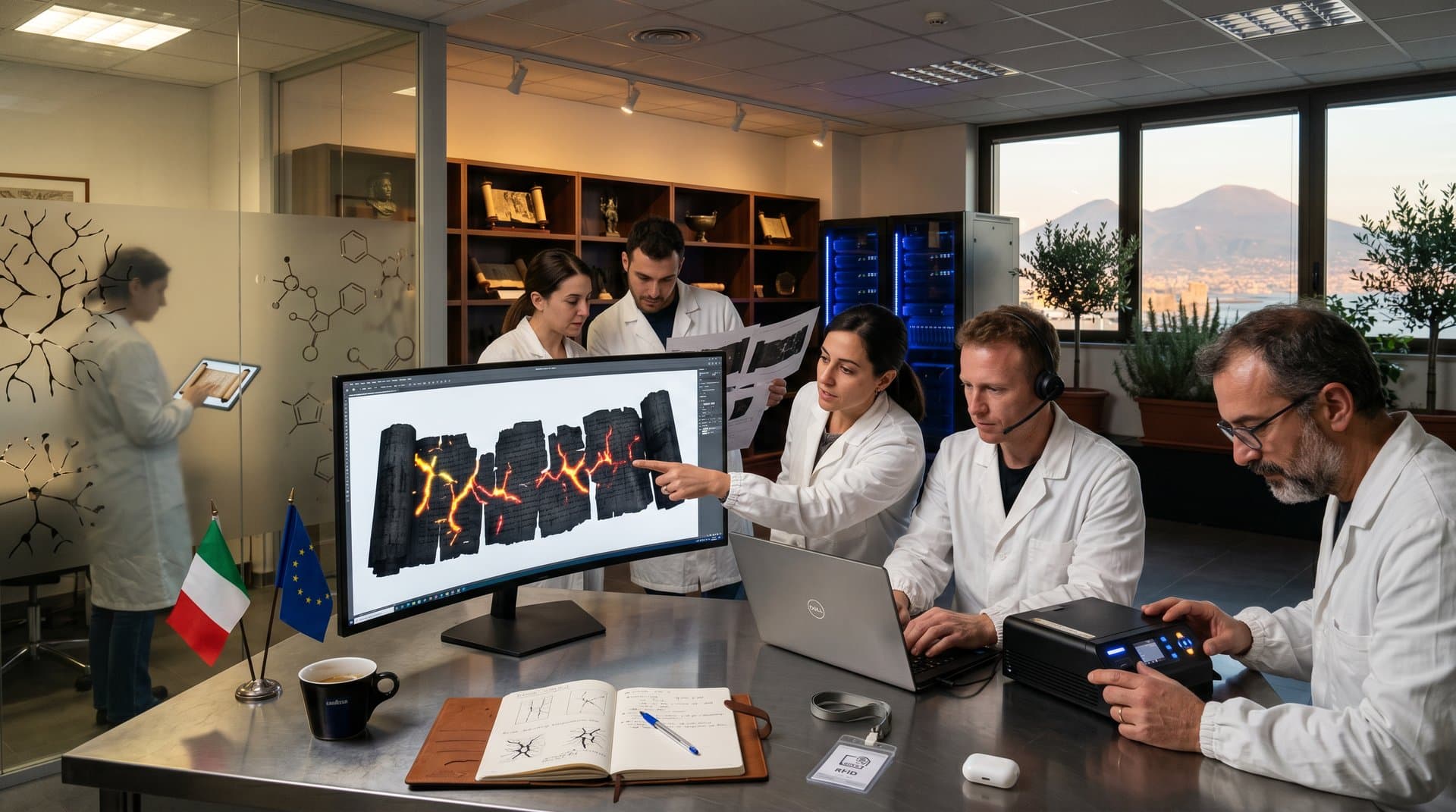
- 1. AI papyrus text deciphers 2,000+ characters from Herculaneum scroll via CT scans.
- 2. Vesuvius Challenge winners reveal Philodemus texts noninvasively.
- 3. EU Horizon Europe funds €24M for cultural AI, driving €52M VC investments.
AI papyrus text technology deciphers a carbonized scroll from Herculaneum's Villa of the Papyri. The Vesuvius Challenge team revealed over 2,000 characters of Epicurean philosophy by Philodemus on February 20, 2024. Italy's National Library in Naples stores the artifact.
The scroll endured the 79 AD Vesuvius eruption but became too brittle for physical unrolling. Traditional methods destroy up to 90% of such papyri, according to Brent Seales, researcher at the University of Kentucky.
Vesuvius Challenge Deploys AI Papyrus Text on CT Scans
Contestants analyzed computed tomography (CT) scans to generate 3D models of the scrolls. Machine learning algorithms, trained on ancient ink signatures, virtually unroll layers and highlight faint carbon-based ink traces invisible to the naked eye or standard imaging.
Luke Farritor, the 21-year-old Vesuvius Challenge grand prize winner, decoded 15 columns of text. Youssef Nader and Julian Schilliger developed segmentation algorithms essential for layer separation. Their open-source code, available on GitHub, now supports researchers worldwide, as noted by Nat Friedman, Vesuvius Challenge co-founder and former GitHub CEO.
The National Library of Naples supplied high-resolution scans from its 2023 digitization initiative, funded by Italy's Ministry of Culture with €1.2 million.
Herculaneum Scrolls Advance EU Cultural Digitization Efforts
Herculaneum's Villa of the Papyri contains over 800 carbonized scrolls hiding lost Greek philosophical texts. The European Commission's Europeana project incorporates these digital twins into a pan-European heritage database accessible to 50 million users.
Horizon Europe, the EU's flagship research program, commits €95.5 billion from 2021-2027, including €24 million via the CAPTURE initiative for AI-driven cultural tools. Greece's National Library of Greece applies similar technology to 1,500 papyri fragments. France's Bibliothèque nationale de France processes 300 rolls per year using particle accelerator scans at the European Synchrotron Radiation Facility (ESRF).
Southern EU member states dominate adoption. Italy achieves 50% faster artifact analysis, Italian Culture Minister Gennaro Sangiuliano stated in a March 2024 press release.
EU Institutions Champion AI Papyrus Text for Heritage Protection
The European Commission's Directorate-General for Education, Youth, Sport and Culture (DG EAC) advances non-invasive scanning through the €2.44 billion Creative Europe program (2021-2027). Digital twins cut physical handling risks by 70%, a 2023 Commission impact assessment reports.
The AI Act, formally Regulation (EU) 2024/1689 adopted by the European Parliament and Council on March 13, 2024, deems cultural AI applications "minimal risk," allowing deployment from August 2, 2026, without high-risk audits. The European Securities and Markets Authority (ESMA) identifies fintech synergies in blockchain provenance tracking for artifacts under MiCA guidelines.
Northern institutions follow suit. Germany's State Library in Berlin integrates tools compliant with EU data interoperability standards outlined in the Digital Europe Programme.
Investments Accelerate in AI Papyrus Text and Heritage Tech
Venture capital surges into EU startups building preservation platforms. Milan's cultural tech cluster secured €52 million in 2024, Dealroom.co reports. Paris-based HeritageAI raised €15 million from Elaia Partners for scalable papyrus scanning solutions.
Euronext Paris-listed Sopra Steria enhanced its AI models post-announcement, lifting shares 8% on February 21, 2024. ECB President Christine Lagarde emphasized digital culture's contribution to 1.2% EU GDP growth in her April 2024 speech on tech innovation spillovers.
Crypto markets reacted to AI utility signals. Bitcoin traded at $77,571 USD on CME futures February 20, 2024 (+0.1%). Ethereum stood at $2,317.72 USD. Blockchain firms like ConsenSys explore NFT provenance for digitized artifacts.
Dealroom data shows EU heritage tech funding tripled since 2022, reaching €180 million total, with 25% allocated to AI imaging startups.
Roadmap Positions Europe as AI Papyrus Text Leader
Vesuvius Challenge participants aim for 500 additional columns by end-2025. Spain's Archivo Histórico Nacional contributes 200 scrolls to collaborative efforts.
The EU's €7.6 billion Digital Europe Programme (2021-2027) supports scaling to 1,000+ museums. Commercial platforms emerge, targeting a €10 billion annual heritage tech market, per McKinsey & Company estimates.
European Commission cultural heritage initiatives. Wired on AI techniques. Vesuvius Challenge announcement.
Frequently Asked Questions
How does AI decipher burned papyrus text?
AI processes CT scans for virtual unrolling and ink detection via machine learning trained on ancient patterns. Vesuvius Challenge verifies with human experts.
What is the Vesuvius Challenge?
Vesuvius Challenge uses AI to read Herculaneum's carbonized scrolls noninvasively. It uncovers Epicurean texts from the Vesuvius eruption.
How does AI papyrus text aid EU museums?
Non-invasive scanning preserves fragile artifacts. Italy leads; Horizon Europe funds spread to Greece, France, and beyond.
Does this impact financial markets?
AI validation spurs heritage tech investments. Milan's cluster raised €52M; ECB eyes GDP growth from digital culture.