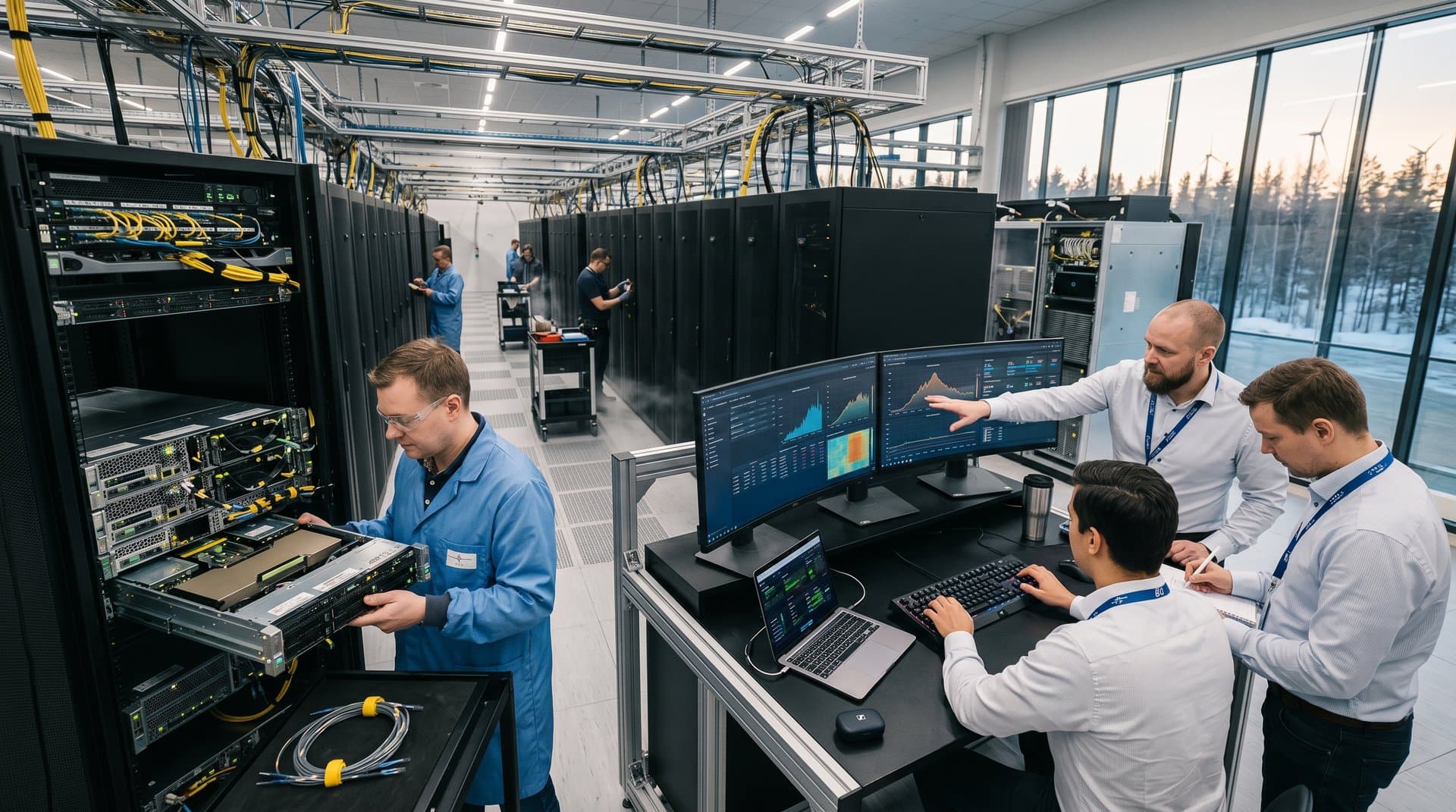
- Draghi report demands €750bn-€1T extra annual investment for EU competitiveness.
- EU AI Act fines reach €35M or 7% global turnover for violations.
- EuroHPC's LUMI delivers 1.508 exaflops for sovereign AI compute.
EU AI infrastructure demands €750 billion to €1 trillion in annual investments. Mario Draghi's competitiveness report, released 9 September 2024, makes this call. European Commission President Ursula von der Leyen commissioned it in 2023. Fragmentation leaves Europe trailing US hyperscalers like Google DeepMind and OpenAI.
The EU AI Act (Regulation (EU) 2024/1689) takes full effect on 2 August 2026. Article 6 regulates high-risk systems. Compute shortages hinder startups from Paris to Warsaw.
US firms operate massive GPU clusters processing petabytes daily. Europe relies on OVHcloud and Deutsche Telekom but lacks scale.
EU AI Infrastructure Remains Fragmented
Member states develop separate clouds. France backs Scaleway. Germany supports IONOS. Duplication inflates costs and blocks data flows, per Draghi's report.
Gaia-X pursues federated sovereign cloud. Interoperability lags. GDPR (Regulation (EU) 2016/679) hampers cross-border AI training.
National authorities enforce the Digital Markets Act inconsistently. Big Tech faces probes. Local firms lack resources. Talent migrates to Silicon Valley.
Draghi Report's Digital Recommendations
Draghi's blueprint seeks €750bn-€1T extra yearly spending, per the report (European Commission, 2024). Public funds attract private capital. Single market reforms cut red tape (Reuters).
Digital infrastructure tops priorities. US clouds—AWS, Azure, Google Cloud—hold two-thirds of global capacity, Draghi notes.
Key measure: Boost Digital Europe Programme by €10bn. It funds AI chips and data pipelines. It aligns with the EU Green Deal for sustainable energy.
EuroHPC's Role in EU AI Infrastructure
EuroHPC Joint Undertaking federates supercomputers across Europe (EuroHPC JU). Finland's LUMI supercomputer delivers 1.508 exaflops. Germany's Jupiter targets 10 exaflops by 2025, per EuroHPC specifications.
Researchers access resources via cloud portals. Sovereign hardware enables AI training without US reliance.
Budget rises to €3bn by 2027. Plans include quantum hybrids. Benchmarks rival US Frontier system.
Energy Powers EU AI Infrastructure
AI data centers demand massive power. Training GPT-4 equivalents consumes 50 GWh, per Lambda Labs estimates. Europe generated 40% renewables in 2023 from North Sea wind and Iberian solar, per Eurostat.
US grids strain under hyperscaler loads. Texas blackouts in 2021 linked to high demands, per ERCOT reports. EU Green Deal targets 45% renewables by 2030.
Offshore wind powers clusters. Denmark's Orsted seals hyperscale deals. Carbon-neutral compute attracts Scope 3-focused firms.
EU AI Act Drives Infrastructure Demand
EU AI Act categorizes risks (EUR-Lex). High-risk systems require audits (Article 15). GPAI models over thresholds disclose training data (Article 52).
Firms build compliant infrastructure. Trusted execution environments secure data. Fines reach €35M or 7% global turnover (Article 101).
Regulation spurs investment. Startups favor Dublin and Amsterdam for low-latency access. Unified EU AI infrastructure accelerates growth.
Public-Private Partnerships Build EU AI Infrastructure
Sovereign funds pool capital. France's 5G model extends to AI. Italy's Cassa Depositi eyes stakes.
Nvidia supplies Grace CPUs to EuroHPC. AMD provides MI300X to Finland. GlobalFoundries expands Dresden chip production.
EU venture capital trails US. EBRD launched €500M tech fund. Tax incentives boost returns.
Finance Gains from Integrated EU AI Infrastructure
Tech sovereignty safeguards Europe's €18 trillion economy (Eurostat 2023). AI empowers fintechs like Revolut and Adyen. Compute access halves inference costs.
Euronext deploys AI for trading. Sovereign infrastructure keeps data in-zone.
Draghi links capital markets union to digital goals. Deeper pools enable infrastructure bonds. Green labels draw ESG funds.
Europe must invest now. US AI venture funding hit $100bn in 2023, per PitchBook. China invested $20bn, per Stanford AI Index 2024. EU AI infrastructure unifies to close the gap.
Upcoming European Council summits shape the 2026 digital agenda.
Frequently Asked Questions
Why does the EU need integrated AI infrastructure?
Fragmentation across 27 states limits scale against US hyperscalers. Unified systems enable shared exaflop compute. Draghi report stresses this for sovereignty.
What does the Draghi report recommend for EU AI infrastructure?
It urges €750bn-€1T extra yearly investment including digital infra. Public-private partnerships build cloud capacity. Ties to single market reforms.
How does EU AI infrastructure relate to the EU AI Act?
The Act requires compliant compute for high-risk systems. Sovereign infra ensures GDPR-aligned training. Fines reach €35M for breaches.
What is EuroHPC's contribution to EU AI infrastructure?
EuroHPC coordinates federated supercomputers like LUMI at 1.508 exaflops. Supports AI research without foreign dependency. Plans quantum integration by 2027.