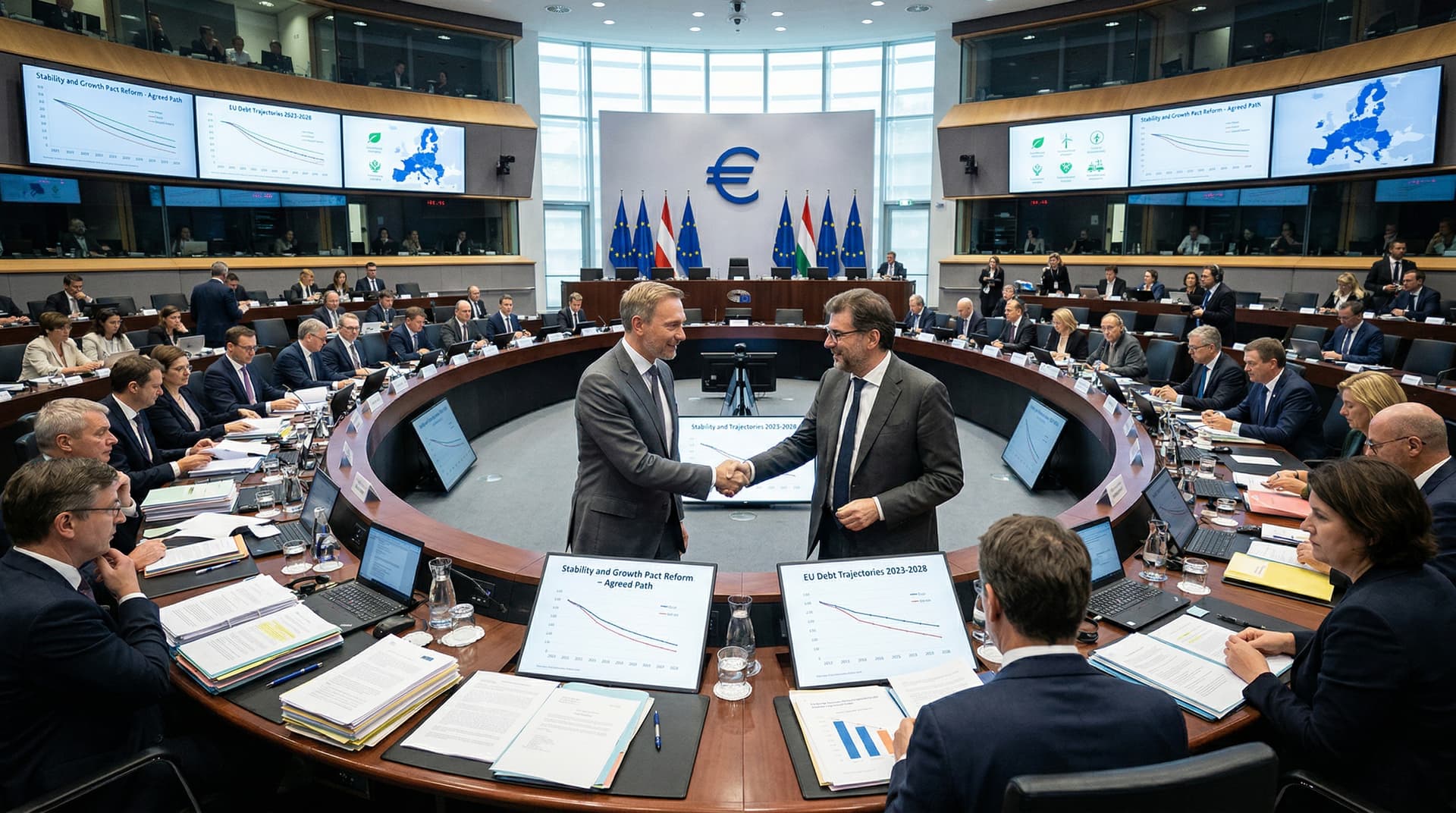
In a significant step for European economic governance, EU finance ministers convened in Luxembourg on June 20, 2023, and reached a political agreement to overhaul the bloc's long-standing Stability and Growth Pact (SGP). This reform, years in the making, introduces a more flexible framework to manage public debt and deficits while safeguarding fiscal sustainability. The deal comes at a critical juncture, as member states grapple with soaring debt levels from the COVID-19 pandemic, the energy crisis triggered by Russia's invasion of Ukraine, and uneven economic recoveries.
The Ecofin Council, chaired by Portuguese Finance Minister Fernando Medina, endorsed the 'two-pillar' approach proposed by the European Commission earlier in 2023. This structure combines medium-term fiscal-structural plans submitted by countries with binding net expenditure paths enforced by the Commission.
Background: The Flaws of the Old Pact
Enacted in 1997 to enforce the Maastricht Treaty's 3% deficit and 60% debt-to-GDP limits, the SGP has been a cornerstone of Eurozone stability. However, its rigid rules proved ill-suited to modern crises. During the pandemic, nearly all EU countries breached the thresholds, prompting a general escape clause activation in 2020, 2021, and 2022. Post-2022, the clause lapsed, reigniting debates over enforcement.
Critics, including Italy and France, argued the one-size-fits-all approach stifled investment in green transitions and defense. Northern 'frugal' states like Germany and the Netherlands pushed for stricter discipline to prevent moral hazard. Negotiations, relaunched under the French EU Presidency in 2022, intensified in 2023, culminating in this compromise.
Key Elements of the Reform
The agreement replaces the blunt deficit targets with net primary expenditure limits, excluding interest payments and pandemic-related spending. Countries will submit multi-year fiscal plans (typically four to seven years) detailing debt reduction trajectories and reforms.
- For high-debt nations (above 90% GDP): Debt must fall by 1% annually on average over four years.
- Medium-debt countries (60-90%): Reduction of 0.5% per year.
- Low-debt states: Focus on preventing increases.
A reference medium-term net primary expenditure path will cap growth in public spending, with deviations requiring compensatory measures. Flexibility buffers include a cyclical adjustment for economic downturns and an investment margin (up to 1.5% of GDP) for green, digital, and defense priorities.
The European Commission will assess plans for 'effective debt sustainability' using a debt sustainability analysis (DSA) toolkit. Enforcement remains graduated: from preventive recommendations to excessive deficit procedures (EDPs) and fines up to 0.05% of GDP, though political safeguards limit harsh penalties.
"This is a win-win: credible rules with room to invest," said Belgian Finance Minister Vincent Van Peteghem, whose country holds the EU presidency until June 30.
Reactions Across the Bloc
Southern Europe hailed the deal. Italian Economy Minister Giancarlo Giorgetti called it "balanced and realistic," noting Italy's 140% debt-to-GDP ratio would benefit from longer adjustment periods. Spain's Nadia Calviño praised the investment safeguards.
Germany's Christian Lindner, a fiscal hawk, expressed satisfaction: "It ensures debt ratios fall over time without exceptions." The Netherlands and Austria also backed the compromise after securing safeguards against backsliding.
France's Bruno Le Maire welcomed the flexibility but stressed the need for growth-oriented reforms. Smaller states like Ireland, with low debt but high growth, appreciated the tailored approach.
Critics, including some economists and Greens in the European Parliament, worry enforcement will remain weak. German Green MP Kai Gehring tweeted: "Better rules, but political will is key."
Implications for EU Economic Policy
The reform aligns with the NextGenerationEU recovery fund, expiring in 2026, which disbursed €225 billion by June 2023. It supports the Commission's 2023 priorities: green deal, digital single market, and strategic autonomy amid US-China tensions.
By allowing debt issuance for common goals, it facilitates joint borrowing debates. ECB President Christine Lagarde, speaking on June 22, noted the pact's evolution aids monetary policy by fostering fiscal space.
For the Eurozone, projected average debt at 88% GDP in 2023 (Eurostat data), the rules avert austerity redux. IMF praised the deal on June 21, calling it "a step toward modernizing the framework."
Challenges persist: Implementation hinges on Council and Parliament approval by late 2023, with transitional rules from 2024 and full effect in 2025. National ownership is crucial to avoid repeats of Greece's 2010 crisis.
Broader EU Affairs Context
This accord bolsters EU unity amid geopolitical strains. As leaders prepare for the June 29-30 European Council, fiscal reform underscores commitment to 'European sovereignty.' It dovetails with progress on the Capital Markets Union and Banking Union, enhancing resilience.
In Hungary and Poland, where rule-of-law disputes freeze funds, the pact reinforces conditionality. Commission President Ursula von der Leyen hailed it as "future-proofing our economy."
As Europe eyes 2030 climate targets and NATO spending hikes, flexible fiscal rules enable ambition without instability. This deal, forged through painstaking compromise, may define the EU's post-crisis governance for decades.
Europe World News will monitor ratification and first plans. Word count: 912