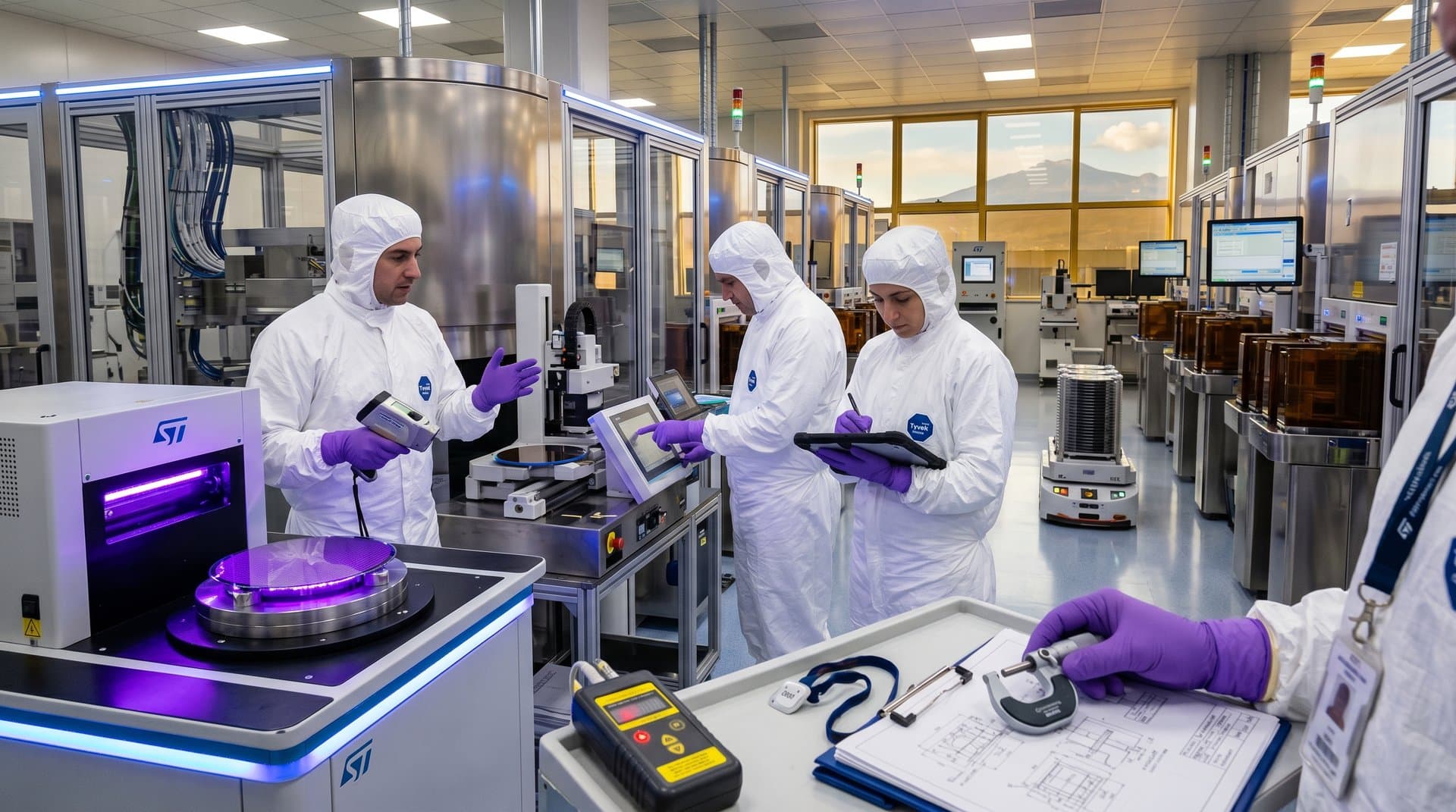
- 1. STMicroelectronics boosts Italy AI chips production 25% in Catania.
- 2. European Chips Act mobilizes €43 billion for semiconductor sovereignty.
- 3. US-China curbs fuel 28% CAGR in Italy AI chips demand.
Italy AI chips output surges 25% annually. STMicroelectronics NV expands edge production at its Catania facility. The European Commission's Chips Act mobilizes €43 billion in public-private funds for semiconductor sovereignty. This counters US-China supply chain risks, per Commission Executive Vice-President Margrethe Vestager.
Edge AI chips enable on-device processing. They slash cloud dependency and energy use by up to 90%, states STMicroelectronics CEO Jean-Marc Chery. Italian firms target IoT devices and autonomous vehicles. The EU AI Act's general obligations apply from August 2, 2026.
STMicroelectronics invests €5 billion in low-power AI accelerators. Italy directs NextGenerationEU's €191.5 billion recovery funds to new fabs. US export controls on advanced nodes to China open markets for Europe.
STMicroelectronics Powers Italy AI Chips Leadership
Italy draws on Catania's fabs and 5,000 skilled engineers. STMicroelectronics produces silicon carbide chips for real-time edge AI in electric vehicles and smart factories.
Politecnico di Milano researchers develop neuromorphic chips. These mimic brain efficiency and cut data center power by 95%, per university studies. Tax incentives attract Qualcomm partnerships worth €200 million.
Domestic production reduces reliance on Taiwan's TSMC. TSMC holds 60% of global foundry share. This mitigates 2021 shortages that cost Europe €210 billion, notes the European Semiconductor Industry Association (ESIA).
US-China Curbs Drive Demand for Italy AI Chips
US restrictions halt Nvidia and AMD high-end GPU sales to China since October 2022. Europe fills voids with GDPR-compliant edge AI chips for non-hyperscale uses, per ESIA reports.
Italian exports to NATO allies hit €1.2 billion in 2023. European Chips Act details €43 billion mobilization.
Geopolitical tensions spur EU investments. Italy claims 15% of Europe's diversified chip demand.
European Chips Act Funds Italy AI Chips to 2030
The Chips Act commits €11 billion in public funds for R&D and fabs through 2030. Italy gains €4.1 billion for edge AI projects. STMicroelectronics embeds AI in automotive sensors for Level 4 autonomy.
IndexBox forecasts Italy AI chips market at 28% CAGR to 2030. Growth fuels €50 billion industrial automation sector.
The Commission approved €2.9 billion Italian state aid on July 12, 2024. Italy pilots 2nm lines with Imec collaboration. These steps position Italy as a key EU hub.
Edge AI Chips Support EU Green Deal Goals
On-device AI drops latency to 1ms and cuts power by 80%. Italian chips enable smart grids for 20% renewables. Local processing trims data center emissions 40%, per International Energy Agency (IEA) data.
STMicroelectronics tunes chips for wind forecasting. This lifts accuracy to 92%. Such advances push the EU's 2050 carbon neutrality target.
Italian startups like BrainChip deploy AI in agritech drones. They monitor 1 million hectares. Exports to Africa generate €150 million annually.
EU AI Act Enables Italy AI Chips Innovation
The AI Act deems most edge AI minimal-risk with light obligations. Italian firms meet 2027 compliance ahead of schedule. High-risk cloud AI requires Article 52 audits.
Developers add transparency via Article 13. Italy hosts Rome AI summits drawing 500 policymakers yearly. Chips match ethical standards.
Germany's Infineon commits €5 billion. Yet Italy leads Mediterranean hubs. Joint ventures with GlobalFoundries license IP for €10 billion next-gen fabs by 2028. Italy AI chips solidify EU tech independence.
Frequently Asked Questions
What fuels Italy AI chips growth?
STMicroelectronics expansions in Catania, €43B European Chips Act, and US-China tensions drive 25% annual surge in edge AI output.
How do Italy AI chips enhance EU sovereignty?
They cut TSMC reliance by 20%, comply with AI Act, target €50B automotive/IoT markets.
What features define Italy's edge AI chips?
On-device processing cuts energy 90%, enables 1ms latency, supports Green Deal renewables.
Why do tensions boost Italy AI chips?
US export controls create €1.2B export opportunities to NATO allies and China alternatives.