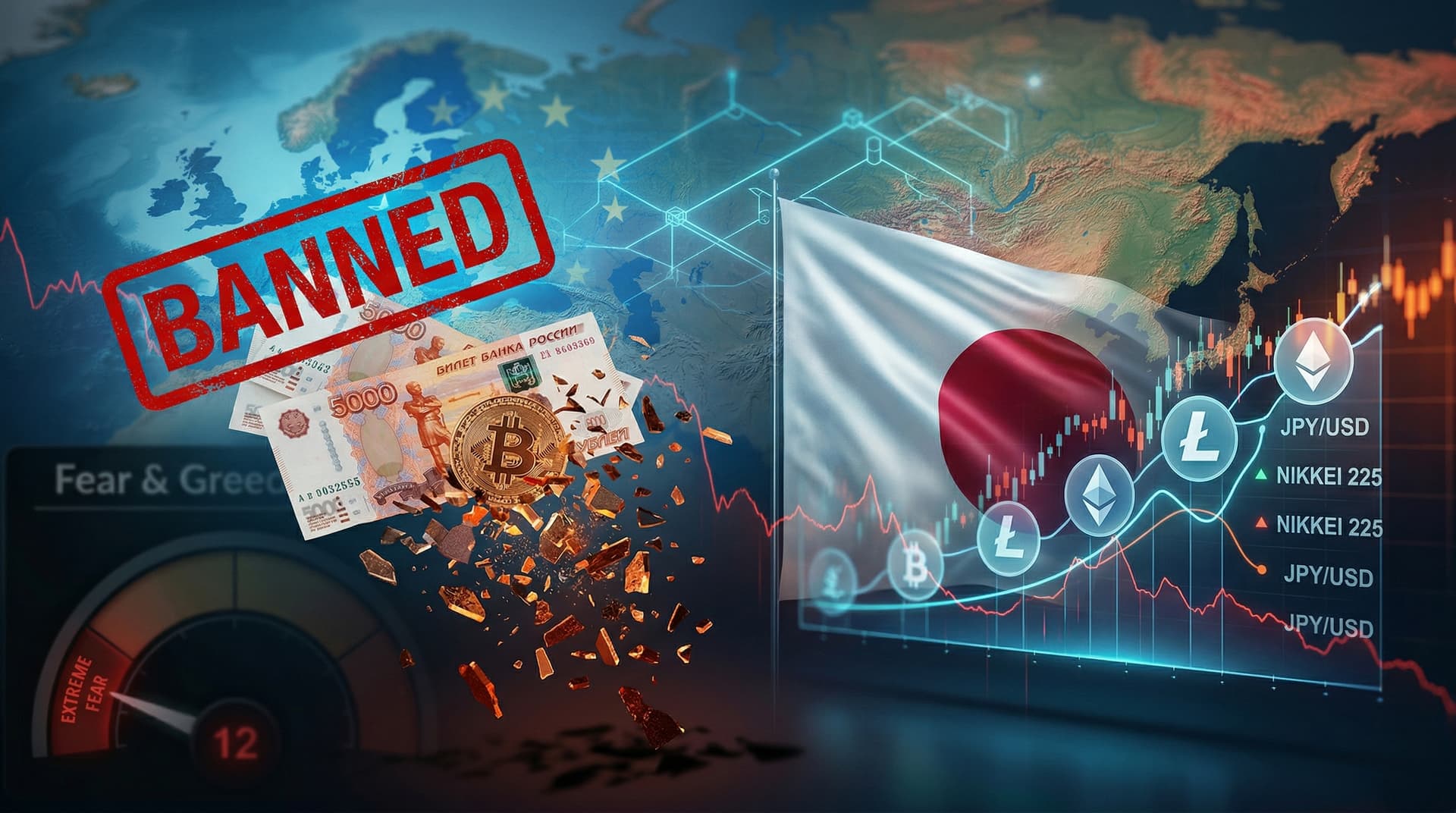
- Russia's ban halts 100% of crypto-to-cash exchanges, disrupting EUR 2.5 billion in annual EU-Russia flows.
- Japan reclassifies crypto as financial products, mirroring MiCA rules across 27 EU member states.
- Fear & Greed Index hits 12 as BTC falls 3.1% to USD 70,764, prompting European portfolio shifts.
By Craig Osborne, EU Correspondent April 13, 2026
Key Takeaways
- Russia's ban halts 100% of crypto-to-cash exchanges, disrupting EUR 2.5 billion in annual EU-Russia flows.
- Japan reclassifies crypto as financial products, mirroring MiCA rules across 27 EU member states.
- Fear & Greed Index hits 12 as BTC falls 3.1% to USD 70,764, prompting European portfolio shifts.
Russia crypto ban Japan MiCA shifts hit markets today. Russia's Central Bank decree blocks all cryptocurrency-to-cash exchanges, while Japan's FSA reclassifies crypto assets as financial products. These moves test the EU's Markets in Crypto-Assets (MiCA) Regulation (EU) 2023/1114.
Wu Blockchain detailed Russia's decree in its weekly top 10 Asia crypto news. The ban targets over-the-counter trades to curb money laundering. European traders scramble for alternatives.
Russia's 100% Ban Disrupts Eurasian Crypto Flows
Russia's Central Bank enacted the prohibition via Federal Law No. 452-FZ. The law blocks all fiat off-ramps for digital assets. Reuters reports implementation starts April 13, 2026.
This action severs a key channel for EU investors. Russia handled EUR 2.5 billion in crypto trades last year, per Chainalysis 2025 Crypto Crime Report. MiCA-compliant platforms in Estonia and Malta lose Russian volume.
Finance experts predict a 15% spike in peer-to-peer trades. Kraken pivots to EU hubs. The ban supports Russia's rouble stabilization push.
"Russia's move isolates its 10 million crypto users," said Nathan McCauley, CEO of Anchorage Digital. He warns of spillover to EU stablecoin liquidity.
Japan's Financial Product Reclassification Aligns with MiCA
Japan's Financial Services Agency (FSA) classifies crypto as "financial products" under amended law. Exchanges now require licensing. Bloomberg confirms the shift starts Q3 2026.
The policy mirrors MiCA's stablecoin and custody rules in Articles 16-27. MiCA mandates transparency for assets over EUR 200 million in circulation. Japanese firms like Bitflyer face audits akin to EU requirements.
Japan's API standards for wallets boost interoperability with MiCA's technical specs. ETH trades at USD 2,192.86, down 4.0%, reflecting market jitters.
"Japan's rules protect 5.6 million retail investors, pressuring EU peers to tighten enforcement," said Masamichi Adachi, chief economist at UBS Japan.
MiCA Framework Faces Asian Stress Test
MiCA, fully effective since December 2024, regulates 27 member states uniformly via the European Commission and EBA oversight. Russia's ban challenges cross-border enforcement. Japan's alignment highlights MiCA's global influence.
The European Commission monitors flows via EBA reports. Unhosted wallet risks could rise 20%. The European Commission MiCA page outlines compliance tools (EUR-Lex 32023R1114).
Investors shift to MiCA-licensed entities like Circle's USDC. BNB drops 2.3% to USD 593.06 amid uncertainty. XRP falls 2.1% to USD 1.33; EU trading volume dips 8%.
European Commission President Ursula von der Leyen emphasized resilience last week. Her team eyes bilateral talks with Tokyo. Sanctions evasion concerns mount.
European Investor Strategies Evolve Amid Fear
The Fear & Greed Index stands at 12, per Alternative.me. Extreme fear drives de-risking. BTC drops 3.1% to USD 70,764, prompting EUR hedging.
Portfolio managers favor MiCA-compliant ETFs. Germany's BaFin approves three new funds holding EUR 500 million. France's AMF pushes DeFi disclosures.
Tech integration accelerates with AI-driven compliance tools. Elliptic deploys MiCA analytics. USDT holds steady at USD 1.00, anchoring liquidity.
"EU investors should allocate 5-10% to Asian-regulated assets for diversification," advises Christian Catalini, founder of Juventas.
Cross-Border Implications for EU Tech Firms
Dutch exchanges report 12% traffic from Russia. Lithuania's crypto sector, 15% of EU volume, braces for losses. MiCA's travel rule (Article 51) mandates transaction tracing.
Japan's move attracts EU venture capital. Total inflows hit EUR 1.2 billion in Q1 2026. Blockchain interoperability via CCIP standards bridges gaps.
The ECB watches stablecoin reserves closely. A EUR-pegged token nears approval. Finance ministers debate Asia reciprocity clauses.
Russia Crypto Ban Japan MiCA Shifts Define Global Edge
Russia's isolation boosts MiCA's appeal as a safe harbor. Japan's convergence validates its tech standards. Yet enforcement gaps persist in non-EU jurisdictions.
The next ECB rate decision on April 24 gauges crypto spillovers. Investor confidence hinges on unified application across 27 states.